 Denis Serden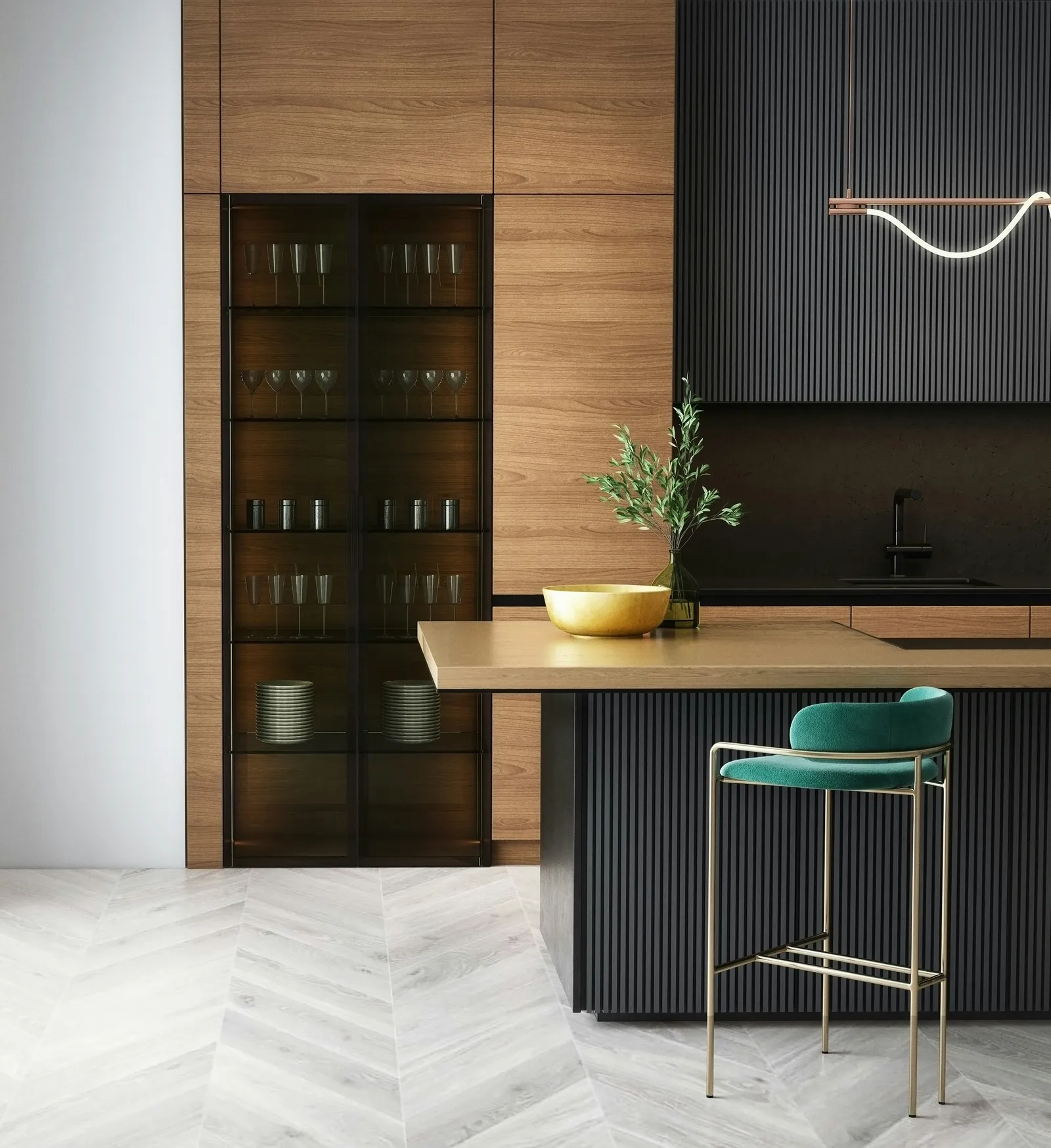
The new kitchen look for 2026 trades cold, all-white minimalism for something warmer and more textured: honey and umber wood-tone cabinetry, bold-veined stone, matte finishes, and warm metal hardware layered together into a space that looks collected rather than showroom-sterile. Where 2020–2023 kitchens chased flat, uniform surfaces and stark contrast, the 2026 look is built on depth, natural material variation, and a softer geometry. For homeowners in Vancouver, WA and Portland, that shift lines up naturally with a regional preference for wood-forward interiors and indoor-outdoor living that this style has been quietly building toward for a few years now.
This isn't a rebrand of "modern farmhouse" or a return to traditional. It's its own aesthetic, and it's showing up in kitchen remodels across the Pacific Northwest right now.
The Core Aesthetic Shift: From Cold Minimalism to Warm Layering
Houzz's 2025 Kitchen Trends Study found that all-white kitchens dropped from 43% of remodels in 2020 to just 26% in 2025, a decline that has continued into 2026 designs. That number tells you the era of flat white boxes and stark contrast is ending. What's replacing it is a kitchen built from natural materials that have visible grain, veining, and texture instead of uniform, factory-smooth surfaces.
The mechanism behind this shift is simple: white cabinetry and quartz with minimal veining photographed well for staged listing photos and Instagram grids between 2018 and 2022, but homeowners living in those kitchens every day found them cold, high-maintenance, and hard to personalize. Wood grain and stone veining don't show fingerprints or scuffs the same way flat paint does, and they age with more character instead of looking dated the moment a trend shifts.
Designers now describe the goal as a kitchen that looks "gathered" over time, not one that looks purchased as a single matched set. That means mixing finishes deliberately: a wood-tone island against painted perimeter cabinets, a honed stone counter next to a fluted metal hood, brushed brass pulls on cabinetry with visible oak grain. Nothing matches exactly, and that's the point.
Cabinetry: Warm Wood Tones Take Over
White oak, walnut, and alder are the three species driving cabinet color in 2026, and all three share a warm, mid-tone base instead of the gray-washed or bright white finishes that dominated the early 2020s. White oak in particular has become the default "neutral" for new kitchen cabinetry, the same role that Shaker-style white painted cabinets played a decade ago.
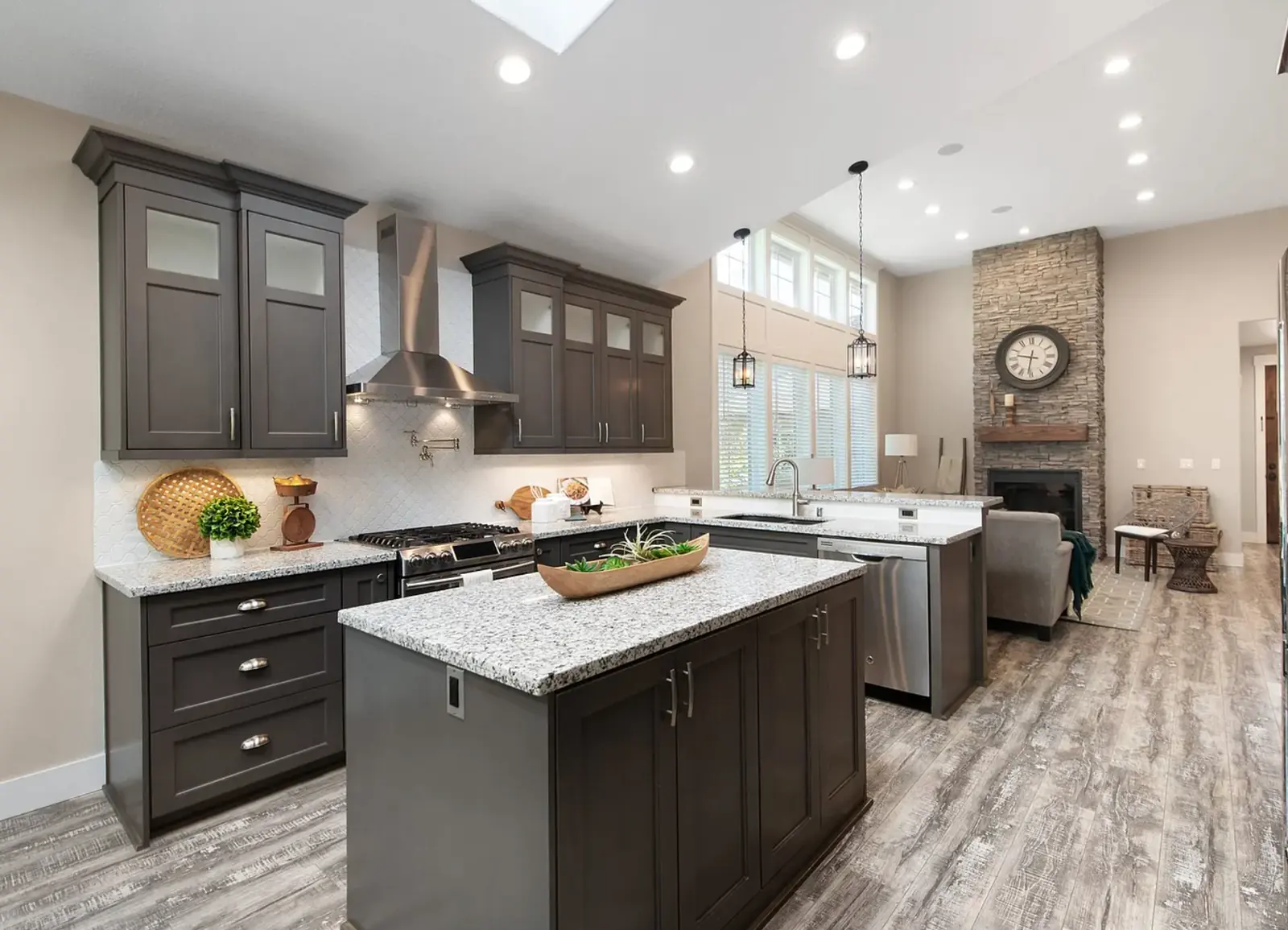
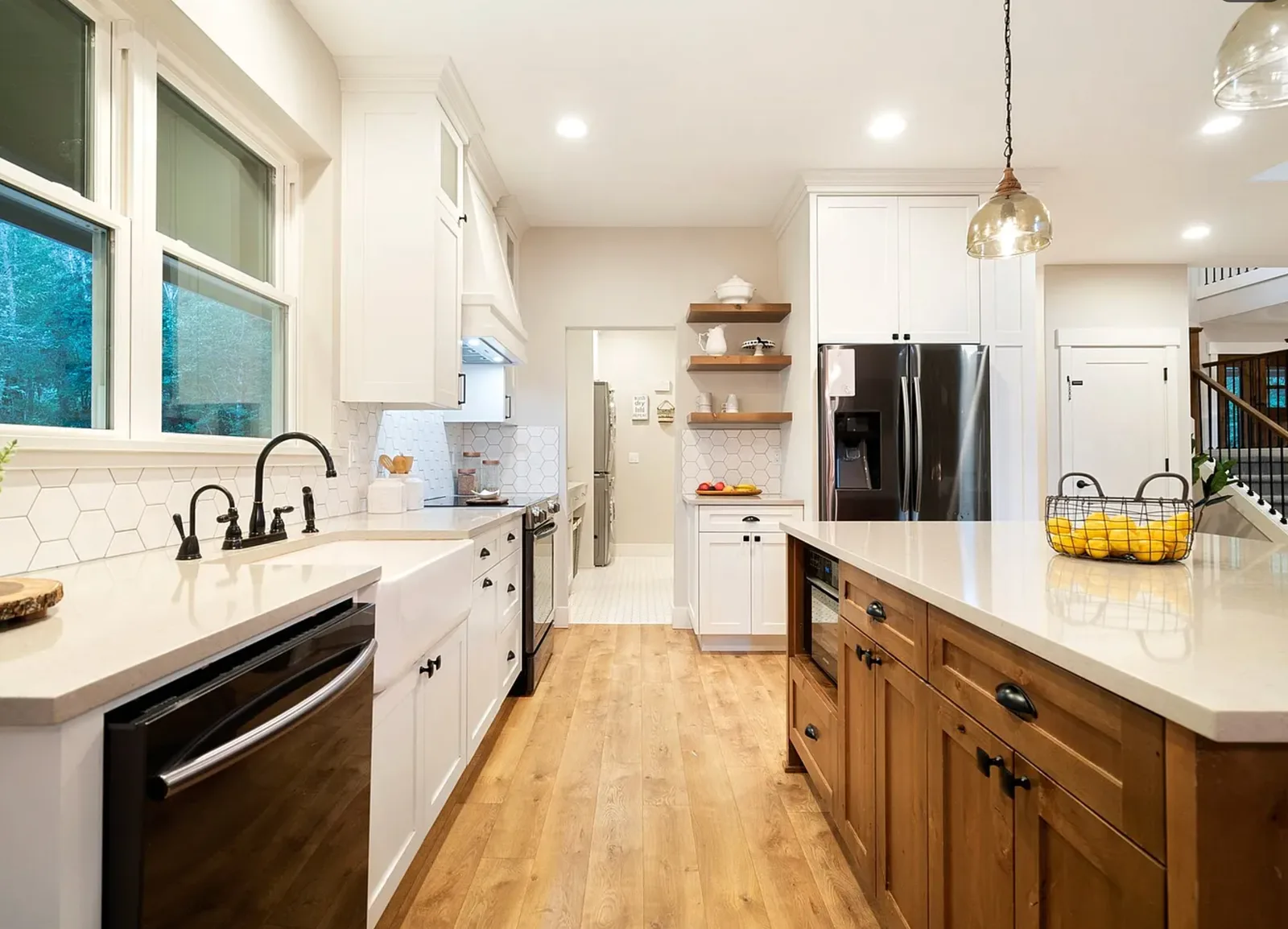
Two-tone cabinet schemes are standard practice now, not a splurge upgrade. A typical layout pairs a wood-tone island with painted perimeter cabinets in a deep, muted color like olive, charcoal, or navy, or it reverses that pairing with a wood-tone perimeter and a contrasting painted island. Flat gray cabinetry, the signature look of 2018–2022 kitchens, has largely dropped out of new design specs entirely. If you're weighing what a cabinet change costs versus a full replacement, our kitchen remodel cost guide for Vancouver, WA breaks down real 2026 price ranges.
Finish matters as much as color. Matte and honed finishes have replaced the high-gloss lacquer look that peaked around 2021. Cabinet doors in 2026 kitchens are more likely to have a slight texture or a low-sheen matte topcoat that reads as natural rather than plastic.
Cabinet Hardware and Metal Finishes
Chrome and matte black, the two dominant hardware finishes of the last remodeling cycle, are being replaced by warmer metals: brushed brass, aged bronze, and unlacquered brass that develops a living patina over time. These finishes pick up the warmth of wood-tone cabinetry instead of fighting it the way cool-toned chrome or flat black does against oak or walnut grain.
Countertops and Backsplash: Bold Veining Over Subtle Pattern
The countertop story in 2026 is about movement, not uniformity. Quartz and natural stone with bold, high-contrast veining have replaced the subtle, barely-there patterns that were popular from 2019 to 2022, when homeowners wanted stone that looked almost solid-colored from across the room.
Waterfall edges remain common, but now they're used specifically to show off dramatic veining as a continuous sheet down the side of an island, turning the counter itself into the kitchen's visual anchor. Backsplashes are following the same logic: full-height slab backsplashes in matching or complementary stone are replacing the small subway tile that defined the previous cycle.
Where tile is still used, it's showing up in warmer, more textured forms: zellige tile with visible glaze variation, fluted ceramic panels, or handmade-look tile with slight irregularity in each piece. The goal across both stone and tile is the same: visible natural variation instead of manufactured uniformity.
Statement Range Hoods as the New Focal Point
The range hood has become the single biggest style statement in a 2026 kitchen, functioning the way a chandelier does in a dining room. Plaster hoods with soft, sculptural curves, wood-clad hoods that match or contrast the cabinetry, and fluted metal hoods in brushed brass or aged bronze are the three leading treatments.
This is a direct departure from 2020–2023 kitchens, where the range hood was typically hidden inside cabinetry or built as a flat, low-profile stainless box designed to disappear. In 2026, it's designed to be seen first.
Layout and Openness: Defined Zones Replace the Open-Concept Free-for-All
Full open-concept layouts, where the kitchen bleeds into the living room with no visual separation at all, are giving ground to layouts with softer, more intentional zoning. Homeowners still want connected spaces, but 2026 kitchens are more likely to use a change in ceiling treatment, a shift in flooring material, or a partial wall or archway to signal where the kitchen ends and the living space begins, without fully closing the room off.
Islands are getting larger and more sculptural, often with curved or rounded corners replacing the sharp rectangular edges that defined minimalist islands from 2018–2022. That curve shows up in cabinetry too: rounded cabinet corners, arched range hood openings, and curved breakfast nooks are appearing in kitchens that would have been all straight lines five years ago.
For Vancouver, WA and Portland homes specifically, this openness philosophy usually extends outward. Sliding or bi-fold doors connecting the kitchen to a covered patio, and moisture-conscious materials like quartz and porcelain that hold up to Pacific Northwest humidity, reflect a regional preference for kitchens that function as an indoor-outdoor hub rather than a closed box.
Lighting: Layered and Warm, Not Single-Source
Lighting design in 2026 kitchens uses multiple warm light sources instead of one dominant overhead fixture. A typical layout includes a statement pendant or a pair of sculptural pendants over the island, under-cabinet task lighting, and often interior cabinet lighting inside open shelving or glass-front uppers. Warm color temperature (2700K–3000K) has replaced the bright, cool-white lighting that made 2020-era kitchens feel clinical.
Old Look vs. New Look: A Side-by-Side Comparison
| Element | 2020–2023 Kitchen Look | 2026 Kitchen Look |
|---|---|---|
| Cabinet color | All-white or flat gray | Warm wood tone (white oak, walnut) or two-tone |
| Cabinet finish | High-gloss or flat matte paint | Matte, honed, natural-grain texture |
| Countertop | Subtle, low-contrast veining | Bold, high-contrast veining |
| Backsplash | Small subway tile | Full-height stone slab or textured tile |
| Range hood | Hidden or flat stainless box | Statement plaster, wood-clad, or fluted metal |
| Hardware | Chrome or matte black | Brushed brass, aged bronze, unlacquered brass |
| Lighting | Bright, cool-white, single source | Warm, layered, multiple sources |
| Island shape | Sharp rectangular edges | Curved corners, sculptural forms |
| Overall feel | Stark, clinical, uniform | Warm, textured, collected |
How to Get the 2026 Look Without a Full Gut Renovation
You don't need to tear a kitchen down to studs to shift its style into 2026. Most of the visual identity described above comes from a handful of surface-level and mid-tier changes that a general contractor can phase in around your budget. Before you set a number, it's worth reading how these upgrades actually pay off — see our breakdown of kitchen remodel ROI in Vancouver, WA and how to plan a realistic 2026 renovation budget.
- Refinish or reface cabinets instead of replacing them. If your cabinet boxes are structurally sound, a wood veneer refacing or a professional refinish in a warm stain can convert flat white or gray cabinetry into the wood-tone look without the cost of new cabinet boxes. Painting the island a contrasting color while leaving perimeter cabinets alone creates the two-tone effect at a fraction of a full cabinet swap.
- Swap the countertop and backsplash together. A new quartz or natural stone slab with bold veining, paired with a matching or complementary full-height backsplash, changes the entire visual tone of a kitchen even if the cabinets and layout stay exactly where they are.
- Replace the range hood as a standalone project. Since the hood is now the kitchen's focal point, upgrading to a plaster, wood-clad, or fluted metal hood delivers an outsized visual impact relative to its cost, especially in a kitchen where the layout won't change.
- Update hardware and lighting fixtures. Swapping chrome or matte black pulls for brushed brass or aged bronze, and replacing a single overhead fixture with layered pendant and under-cabinet lighting, are two of the lowest-cost, highest-impact changes available.
- Add curves where you can. If a full island replacement isn't in the budget, rounded corner trim, a curved breakfast bar overhang, or an arched cutout above the range can introduce the softer geometry that defines the 2026 look without a structural remodel.
A partial remodel that combines two or three of these moves — wood-tone cabinet refinishing plus a new hood plus updated hardware, for example — gets a kitchen most of the way to the 2026 aesthetic without the cost or disruption of relocating plumbing, electrical, or walls. You can see the range of what's possible across our kitchen remodeling and interior remodeling work.
If your kitchen still has flat white cabinets and cool chrome hardware, the three moves with the biggest visual payoff are refinishing or refacing cabinets in a warm wood tone, upgrading to a statement range hood, and swapping hardware for brushed brass or aged bronze — none of which require moving plumbing or electrical.
Frequently Asked Questions
What is replacing all-white kitchens in 2026?
Warm wood-tone cabinetry in white oak, walnut, and alder is replacing all-white kitchens, often paired in two-tone schemes with a painted island or perimeter in a deep, muted color. Houzz reports all-white kitchens fell from 43% of remodels in 2020 to 26% in 2025, with wood tones leading the shift.
Is gray kitchen cabinetry outdated for 2026?
Flat, cool-toned gray cabinetry, the dominant look from roughly 2018 to 2022, is largely out of step with 2026 design direction. Warmer, wood-forward palettes and deeper muted colors like olive and charcoal have replaced gray as the go-to non-white choice.
Do I need an open-concept kitchen to get the 2026 look?
No. The 2026 look favors defined zones within a connected space, using ceiling changes, flooring shifts, or partial walls to signal the kitchen's boundary rather than a fully open floor plan. A kitchen with existing walls can still achieve the aesthetic through cabinetry, countertop, and lighting choices.
What's the fastest way to update a kitchen's look without a full remodel?
Refinishing or refacing cabinets in a warm wood tone, replacing the countertop and backsplash together, and upgrading the range hood and hardware deliver the biggest visual change for the lowest disruption. These projects don't require moving plumbing or electrical and can typically be phased over time. Our kitchen remodel guide for Vancouver, WA walks through how these phases typically come together.
Are matte finishes better than glossy for 2026 kitchens?
Matte and honed finishes are the dominant choice for 2026 cabinetry and countertops, replacing the high-gloss lacquer look popular around 2021. Matte surfaces show less fingerprint and smudge wear and read as more natural against wood-tone cabinetry.
Does the 2026 kitchen look work well in Pacific Northwest homes specifically?
Yes. The warm wood-tone, texture-forward aesthetic pairs naturally with the Pacific Northwest preference for natural materials and indoor-outdoor connection, and moisture-conscious materials like quartz and porcelain hold up well in the region's humidity. Many Vancouver, WA and Portland homeowners are already leaning this direction in their material choices.
If your kitchen still has the flat white cabinets and cool chrome hardware of the early 2020s, you don't need a full gut job to bring it into 2026. Serden Group has completed more than 1,500 remodeling projects across the Vancouver, WA and Portland metro area over 20-plus years in business, and our design team can walk through your space and show you exactly which changes — cabinetry, countertops, a statement hood, hardware — will move your kitchen furthest toward this look within your budget. We keep a dedicated crew on your project from start to finish, back every job with a full warranty, and offer flexible financing including monthly payment plans. Projects over $10,000 currently qualify for up to $2,500 in savings. Book a no-pressure design consultation or call (360) 836-7775 to see what a 2026-style kitchen would look like in your home.