 David Brichka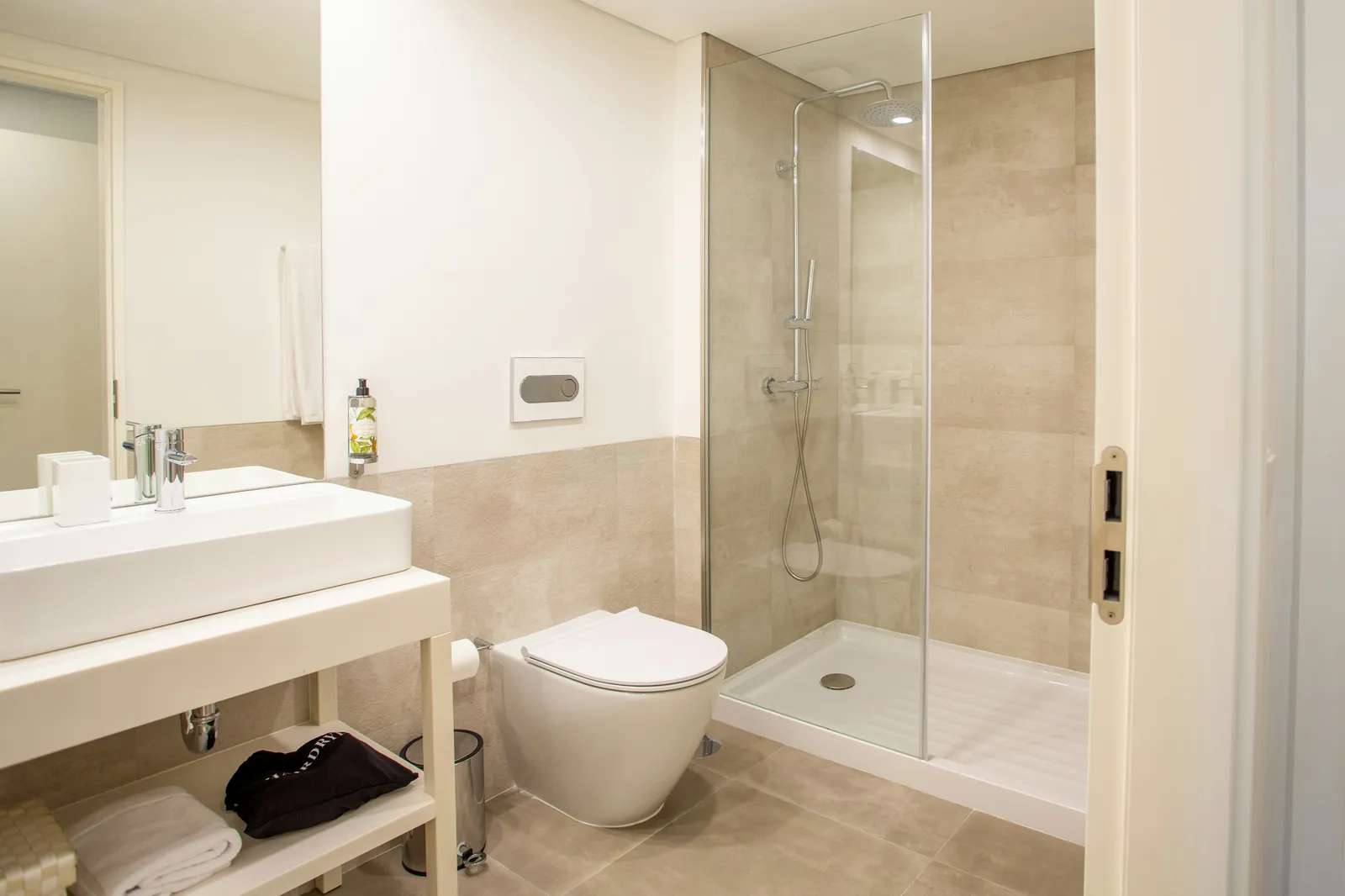
Labor is the most expensive part of a bathroom remodel, typically consuming 40% to 50% of the total project budget. Within that labor category, plumbing relocation and custom tile or shower work are the two line items that push costs higher than any single fixture or material purchase.
That answer surprises a lot of homeowners in Vancouver and Portland who assume the vanity, the tile, or the shower glass will be their biggest expense. Materials matter, and a custom tile shower can run $8,000 or more on its own. But the crews who cut, fit, plumb, waterproof, and finish every square inch of a 5-by-8 room are the reason bathroom remodels cost what they do. If you've asked where your remodel budget actually goes, this article breaks the project down by cost driver, not by budget tier, so you can see exactly which decisions move the needle.
Labor: The Single Largest Cost Category in Any Bathroom Remodel
Labor accounts for 40% to 50% of a typical bathroom remodel budget in the greater Vancouver-Portland area, more than plumbing fixtures, tile, cabinetry, and countertops combined. That percentage holds true across most mid-range projects because a bathroom is the most labor-dense room in a house per square foot.
Here's the mechanism behind that number. A kitchen spreads its labor across a large footprint with fewer trades touching any one section. A bathroom crams plumbing, electrical, tile setting, waterproofing, carpentry, and finish work into 35 to 60 square feet, and each trade has to work around the others in a tight space. A licensed plumber, an electrician, a tile setter, and a finish carpenter may all touch the same 8-foot wall during a full remodel. That coordination takes time, and time is what you're paying for when you see a labor line item on your estimate.
Homeowners often try to cut costs by buying their own materials and hiring a contractor for labor alone. That approach rarely saves money the way people expect. Skilled tile setters, licensed plumbers, and experienced carpenters charge for their time regardless of who sourced the tile or the faucet, and mismatched materials can create installation problems that add hours back onto the labor bill.
Plumbing Relocation: The Line Item That Blows Up Budgets
Moving a toilet, sink, or shower drain is one of the single most expensive changes you can make to a bathroom, often adding $2,000 to $5,000 or more to a project that otherwise stays within a predictable range. Plumbing relocation costs more than almost any other decision because it triggers a chain of expensive requirements: a permit pull, potential slab-cutting on a concrete foundation, subfloor access on a wood-framed home, and licensed plumber labor billed at trade rates.
Many Vancouver and Portland homes built before the 1990s sit on slab foundations in ground-level bathrooms, which means relocating a drain line requires jackhammering concrete, running new pipe, and repouring the slab before any finish work starts. Homes with crawl spaces or basements make access easier but still require a licensed plumber to reroute supply and waste lines to code, and Washington and Oregon both require permitted plumbing inspections before you can close up the wall.
Serden Group tip: Keeping your toilet, tub, and sink in their existing locations is the single biggest cost-saving decision most homeowners can make. Reusing existing plumbing rough-in points can cut thousands off a remodel without touching the finish quality of the room at all.
The Shower or Tub System: The Most Expensive Material Assembly
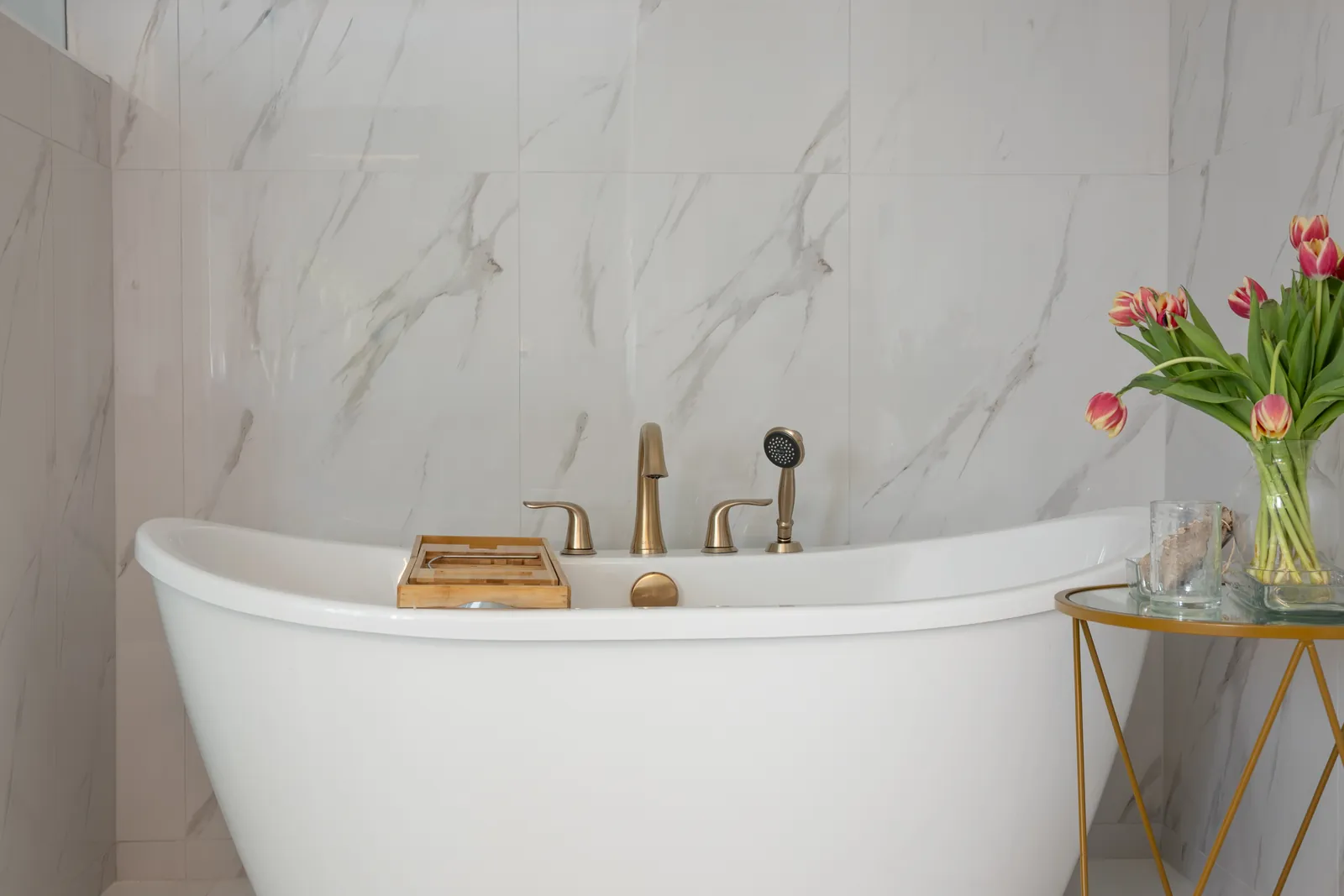
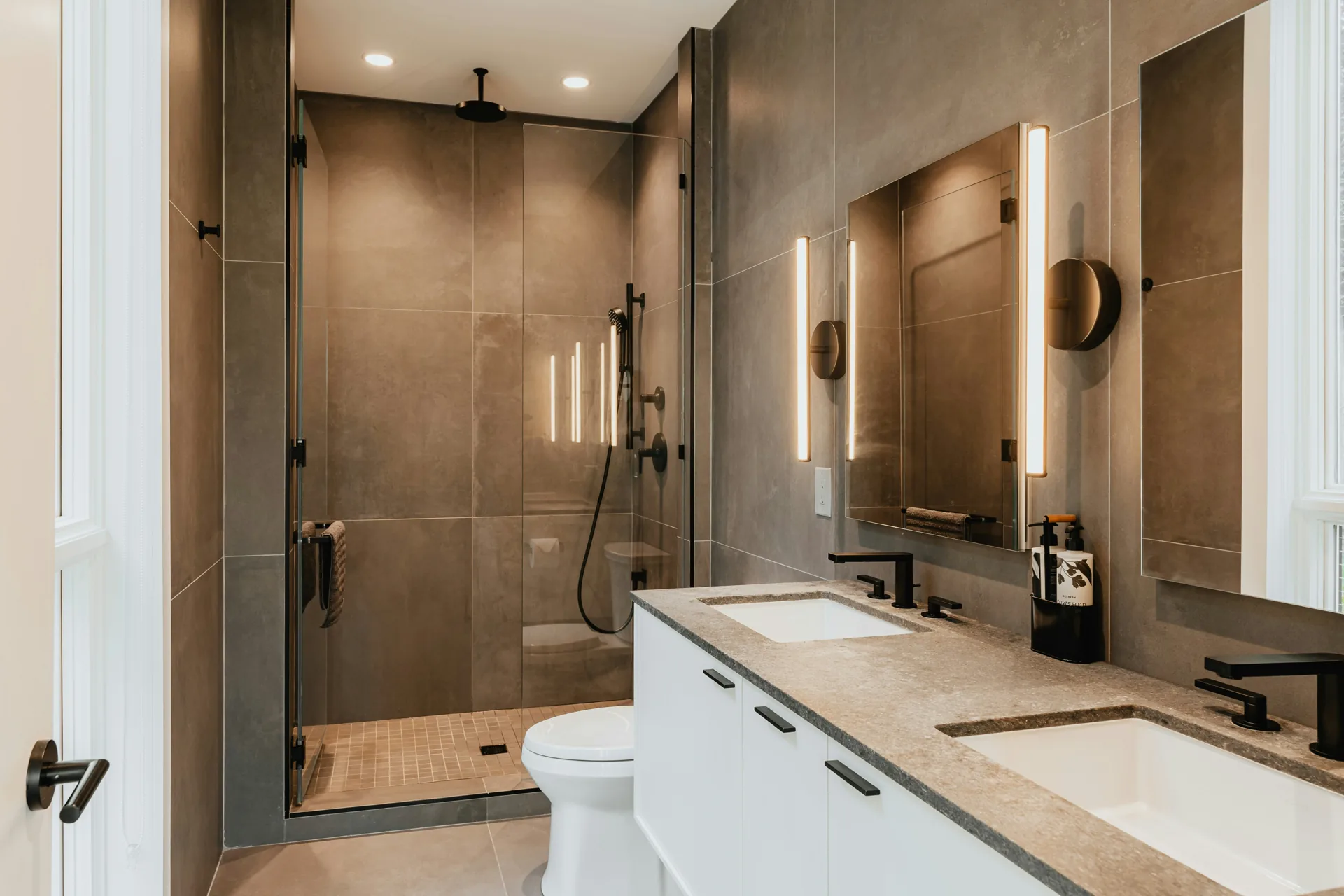
The shower or tub system — meaning the tile, waterproofing membrane, glass enclosure, and fixtures combined — is usually the single most expensive material assembly in the bathroom. A basic prefab shower surround with a standard valve runs $1,500 to $3,000 installed. A custom tile shower with a linear drain, waterproofing membrane, and frameless glass enclosure runs $8,000 to $18,000 or more, depending on tile selection and shower footprint.
The gap between those two numbers comes down to labor hours, not material cost alone. A prefab surround installs in a day. A custom tile shower requires framing adjustments, a waterproofing membrane system like Schluter-Kerdi or a liquid-applied membrane, a mud bed or cement board substrate, precise tile layout around a linear or center drain, grout or epoxy grout application, and a glass installer who measures and fits the enclosure after the tile cures. Each of those steps is a separate skilled trade pass, and each one adds labor hours that show up in the final invoice.
Frameless glass alone typically adds $800 to $1,500 over a framed or curtain enclosure. Large-format tile, which requires more precise substrate leveling, often costs more to install per square foot than smaller subway tile, even when the material price per box is similar. In the Pacific Northwest specifically, the waterproofing membrane behind the tile isn't optional. It's the barrier that keeps 42 inches of annual rainfall and 75-85% indoor humidity from turning into mold and rot behind your shower wall within a few years.
Cabinetry and Vanities: The Second Biggest Material Cost
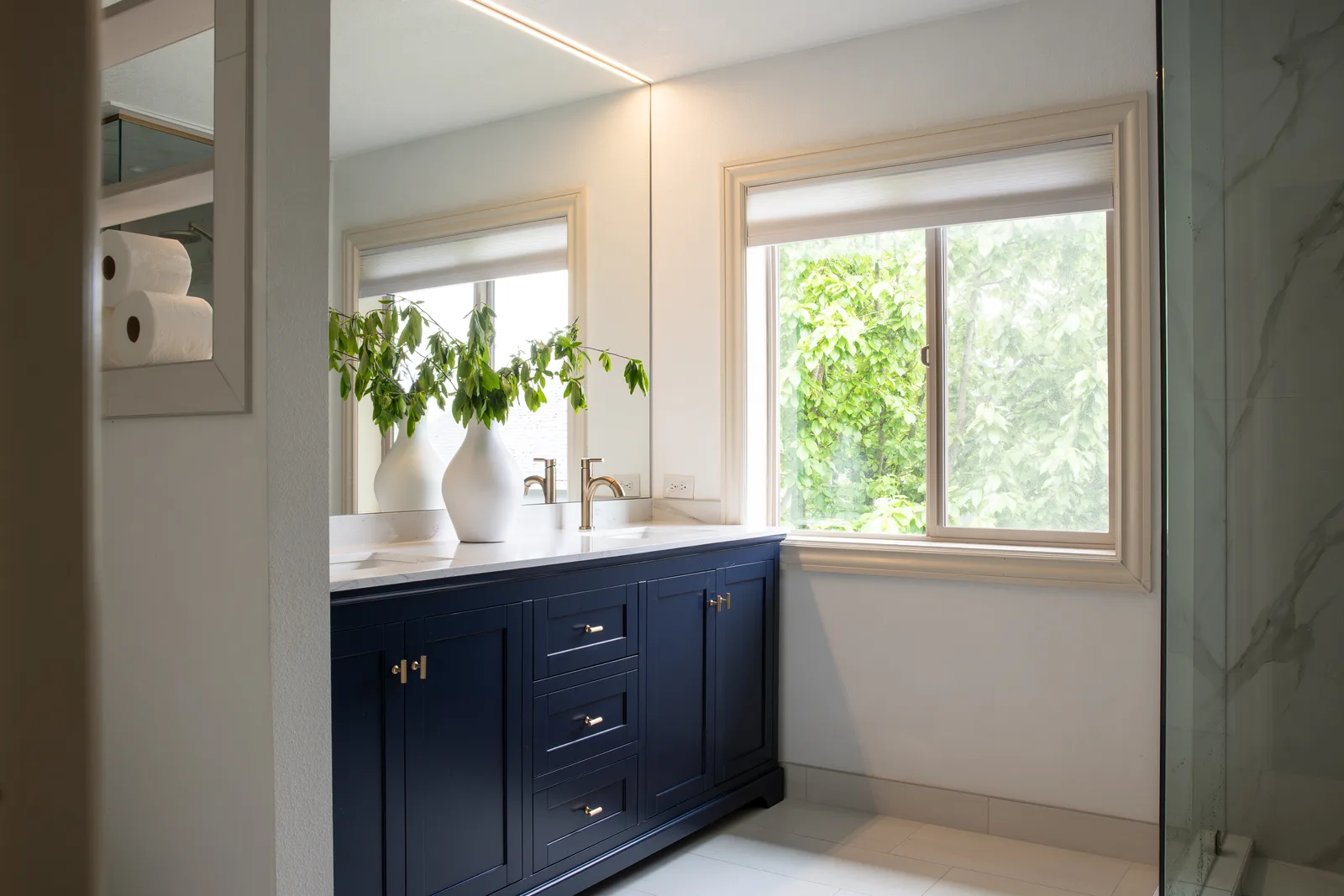
Vanities and cabinetry rank second only to the shower system as a material expense, typically running 10% to 15% of total project cost. A stock 30-inch vanity with a laminate top installed by your contractor might run $600 to $1,200. A custom or semi-custom vanity with soft-close drawers, dovetail joinery, and a solid wood face frame can run $2,500 to $5,000 or more before the countertop is even factored in.
The price jump between stock and custom cabinetry comes from three things: material grade, joinery method, and finish work. Stock cabinets use particleboard or plywood boxes with a laminate or thin veneer finish. Semi-custom and custom cabinetry use solid wood face frames, real dovetail joints, and factory-applied finishes that hold up to bathroom humidity far longer than a big-box laminate box. In a climate where indoor humidity regularly sits above 75% for half the year, that construction quality difference isn't cosmetic. Cheap particleboard cabinetry swells and delaminates faster in a humid Vancouver or Portland bathroom than it would in a drier climate.
Countertops: Small Footprint, Real Cost Impact
Countertops typically represent 5% to 8% of a mid-range bathroom remodel budget, a smaller slice than labor or the shower system but still a meaningful swing factor. Laminate countertops run $20 to $40 per square foot installed. Quartz, the material most homeowners choose for a vanity today, runs $60 to $120 per square foot installed depending on edge profile, sink cutout, and slab grade.
On a standard 6-foot vanity, that difference between laminate and quartz can mean $600 to $1,500 in added cost. Quartz earns its price premium through durability: it resists staining, scratching, and moisture penetration far better than laminate, which matters in a room where standing water and steam are daily occurrences. Granite and marble sit in a similar price range to quartz but require periodic sealing, which quartz doesn't.
Permits and the Pacific Northwest Moisture Problem
Permits and contingency for unforeseen conditions typically account for 5% to 10% of total remodel cost, and in older Vancouver and Portland homes, that number often runs higher once a contractor opens the wall. Clark County and the City of Portland both require permits for plumbing relocation, electrical work, and structural changes, and permit fees alone can run $200 to $800 depending on scope.
The bigger financial risk isn't the permit fee. It's what inspectors and contractors find once demolition starts. Homes built before 2000 in the Pacific Northwest frequently have subfloor rot, deteriorated waterproofing behind old tile, or mold growth in wall cavities that no one could see until the old shower surround came out. With 42 inches of annual rainfall and humidity that sits between 75% and 85% from October through April, moisture finds its way into gaps in old grout lines, failed caulk joints, and undersized bathroom fans over years of use.
A homeowner who budgets zero contingency for hidden damage often ends up with a stalled project and a change order for $1,000 to $4,000 in unplanned subfloor or framing repair. Building a 10% contingency into your budget from the start, rather than treating it as optional, is the difference between a remodel that stays on schedule and one that stops mid-project waiting on a change order approval.
Small Bathroom vs. Full Bathroom Remodel: How Costs Stack Differently
Cost drivers shift depending on whether you're remodeling a small powder room, a standard hall bath, or a full primary bathroom, and the percentage each category represents changes with scope.
Small and Powder Bathroom Remodels
In a small bathroom or powder room under 40 square feet, labor represents an even larger share of the total budget, often 50% or more, because fixed labor costs like permit coordination, demolition, and plumbing rough-in don't scale down proportionally with square footage. A powder room remodel might have no shower at all, which removes the single biggest material cost from the equation and shifts the weight of the budget almost entirely onto labor, the vanity, and the toilet relocation if one is planned.
Full Bathroom and Primary Suite Remodels
In a full bathroom or primary suite remodel, the shower or tub system becomes the dominant material cost, frequently rivaling or exceeding labor as a raw dollar figure even though labor still represents the largest percentage category. Primary suite remodels also tend to add double vanities, freestanding tubs, and heated flooring, each of which adds its own labor pass and material cost on top of the baseline shower and cabinetry work.
Where Your Money Actually Goes: Percentage Breakdown
The table below reflects a typical mid-range bathroom remodel in the Vancouver-Portland metro, based on project data from Serden Group's completed jobs across Clark County and the greater Portland area.
| Cost Category | % of Budget | Typical Driver |
|---|---|---|
| Labor (all trades combined) | 40% – 50% | Plumbing, tile setting, waterproofing, carpentry |
| Shower or tub system | 20% – 25% | Tile, membrane, glass enclosure, fixtures |
| Cabinetry / vanity | 10% – 15% | Solid wood construction, dovetail joinery, soft-close hardware |
| Countertops | 5% – 8% | Quartz slab grade, edge profile, sink cutout |
| Fixtures / fittings | 5% – 8% | Faucet grade, valve type, toilet model |
| Flooring | 5% – 8% | Tile size, heated floor option, waterproof substrate |
| Permits / contingency | 5% – 10% | Permit fees, hidden subfloor or framing damage |
How to Reduce These Costs Without Sacrificing Quality
The biggest savings come from decisions that avoid triggering extra labor, not from downgrading materials. Since labor drives 40% to 50% of your budget, the fastest way to lower total cost is to reduce the number of trade passes a project requires, not to buy a cheaper vanity.
- Keep the plumbing where it is. Reusing existing rough-in locations for the toilet, tub, and shower drain avoids the slab-cutting, permitting, and licensed plumber hours that add $2,000 to $5,000 to a project. If you want a different sink or vanity size, look for one that fits the existing drain and supply line footprint rather than moving them.
- Choose a prefab or semi-custom shower system. A quality prefab surround with a solid valve and glass door runs $1,500 to $3,000 installed, versus $8,000 to $18,000 for a full custom tile shower with a linear drain. Some manufacturers now make prefab shower pans and wall panels that look close to tile at a fraction of the install time, since they skip the mud bed, membrane layering, and multi-day tile setting process.
- Buy semi-custom cabinetry instead of fully custom. Semi-custom vanities use the same solid wood face frames and dovetail joinery as full custom cabinetry, just in standard sizes instead of built-to-measure dimensions. That alone can save $1,000 to $2,000 on a single vanity without dropping to particleboard construction that swells in a humid bathroom.
- Bundle your trades under one coordinated crew. Coordinating a plumber, electrician, tile setter, and carpenter yourself often adds scheduling gaps where one trade waits on another. A general contractor running an in-house crew supported by licensed, vetted trade partners — all coordinated by one project manager — keeps labor hours tighter because the schedule doesn't stall waiting on trades that answer to no one.
- Build your contingency in up front. A 10% contingency line doesn't add cost. It prevents a stalled project when a crew opens the wall and finds subfloor rot behind 20-year-old tile, which happens often enough in Pacific Northwest homes that skipping this line is the riskier move. If you're still shaping the numbers, our home renovation budget guide walks through how to set a realistic figure by tier.
Frequently Asked Questions
What percentage of a bathroom remodel budget goes to labor?
Labor typically consumes 40% to 50% of a bathroom remodel budget in the Vancouver-Portland area. That share is higher than in most other rooms because a bathroom packs plumbing, electrical, tile setting, waterproofing, and carpentry into a small footprint, forcing multiple skilled trades to work in sequence within the same tight space.
Does moving a toilet or shower drain really cost thousands of dollars?
Yes. Relocating a toilet, sink, or shower drain commonly adds $2,000 to $5,000 or more to a project because it requires a permit, licensed plumber labor, and often slab-cutting or subfloor access. Keeping fixtures in their existing rough-in locations is the single most effective way to avoid this cost.
Is a custom tile shower worth the extra cost over a prefab surround?
A custom tile shower costs $8,000 to $18,000 versus $1,500 to $3,000 for a prefab surround, and the difference comes down to design flexibility and resale appeal rather than durability alone. A quality prefab system with proper waterproofing performs just as well functionally, so the decision usually comes down to whether custom tile matters to your design goals or your home's resale value.
Why does bathroom cabinetry cost so much more than kitchen cabinetry per foot?
Bathroom vanities often use the same solid wood construction and joinery as kitchen cabinets, but the higher humidity in a bathroom, especially in the Pacific Northwest where indoor humidity sits at 75% to 85% for much of the year, requires better material grade and finish quality to prevent swelling and delamination. That durability requirement pushes the price of a quality vanity above what a comparable stock kitchen cabinet would cost.
Should I set aside a contingency budget for a bathroom remodel?
Yes, a contingency of 5% to 10% of total project cost is standard for good reason. Homes built before 2000 in the Vancouver-Portland area frequently have hidden subfloor rot or failed waterproofing behind old tile that only becomes visible once demolition starts, and a contingency prevents that discovery from stalling your project.
Can I save money by buying my own materials and hiring a contractor for labor only?
This approach rarely saves as much as homeowners expect. Skilled tradespeople charge for their time regardless of who purchased the materials, and materials sourced outside a contractor's supply chain can create fit or compatibility issues that add labor hours back onto the job, offsetting whatever was saved on the material purchase.
Every bathroom is different, and the only way to know your real cost breakdown is a detailed walkthrough of your specific space, plumbing layout, and material choices. Request your free on-site estimate from Serden Group. We handle bathroom remodels in Vancouver, WA and across Portland, OR — including Camas, Washougal, Battle Ground, Ridgefield, and the surrounding metro.